


The Bond Market Is Sending a Message
August 21, 2026
What rising long-term yields mean for borrowers, equities, and fixed-income investors.
The bond market rarely receives the same attention as the stock market. Stocks are easier to follow, more familiar to most investors, and historically the primary engine of long-term portfolio growth. But every so often, the bond market begins sending a message that investors should not ignore.
This appears to be one of those periods.
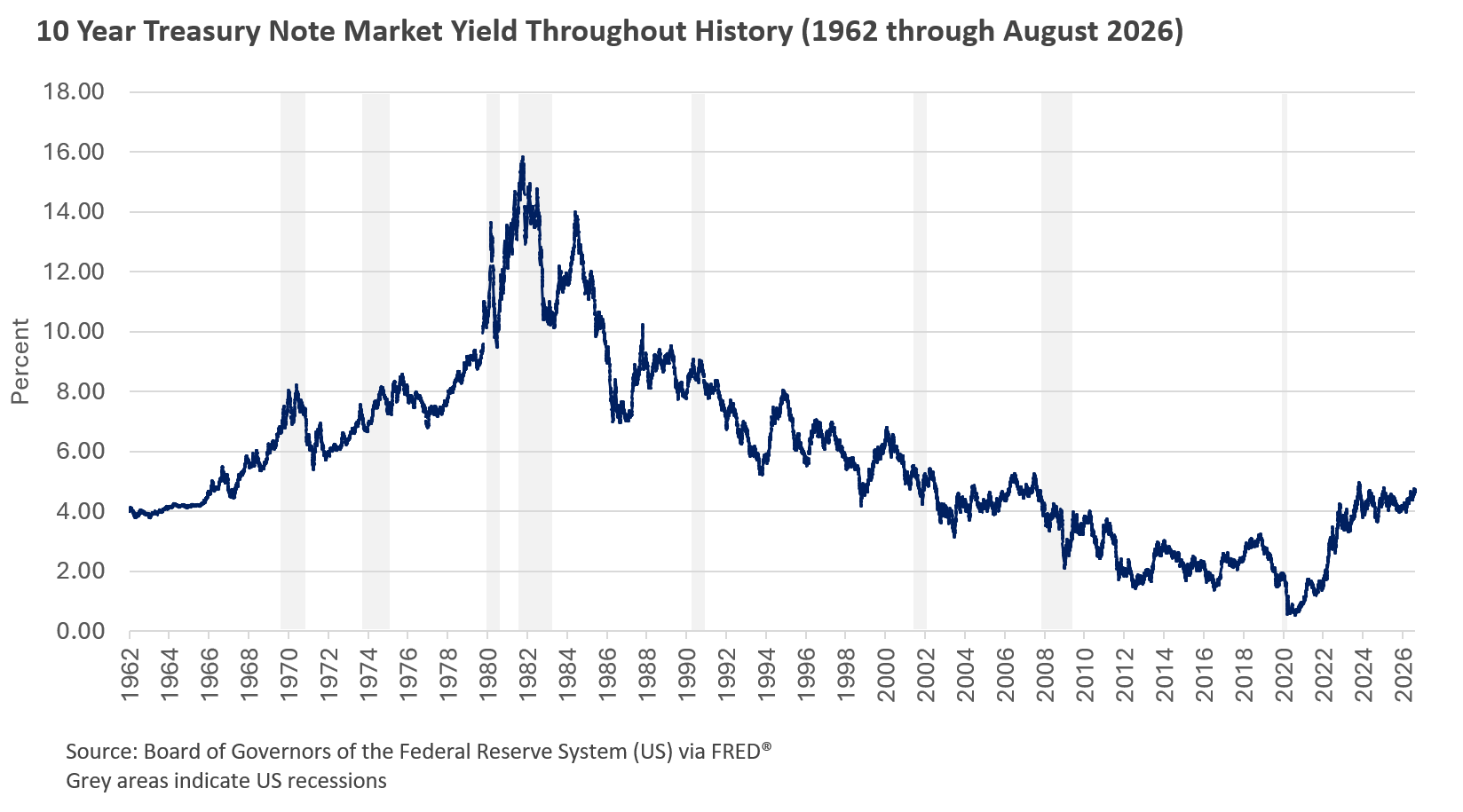
Long-term government bond yields have risen sharply in the United States and overseas. Earlier this week, the yield on the 30-year U.S. Treasury briefly climbed above 5.3%, its highest level since 2007, while the 10-year yield approached 4.75%. Because bond prices and yields move in opposite directions, the rise in yields has produced meaningful losses for holders of longer-duration bonds.
These moves also matter well beyond the bond market. Treasury yields influence mortgage rates, corporate borrowing costs, government finances, and ultimately the relative value of stocks and other investments.
Why Are Long-Term Rates Rising?
There is no single explanation. Rather, several forces have converged to push long-term yields higher.
Inflation remains an important part of the story. The Federal Reserve has made considerable progress since inflation peaked several years ago, but inflation remains above the 2% objective. More recently, higher oil prices and renewed geopolitical tensions have raised concerns that energy costs could slow or reverse that progress.
For bond investors, that concern is significant because inflation erodes the purchasing power of a bond’s fixed interest and principal payments. If investors believe inflation may remain elevated, they will generally demand a higher yield as compensation.
The distinction between short- and long-term interest rates is also important. The Federal Reserve directly controls a short-term policy rate, but it has much less control over the long end of the yield curve. Longer-term rates reflect the market’s collective expectations for inflation, economic growth, government borrowing, and the risks associated with committing capital for many years.
One way to think about this is through the “term premium,”which is simply the additional return investors demand to hold a long-term bond rather than repeatedly investing in shorter-term securities. That premium remained unusually low for much of the period following the global financial crisis. Today, investors appear to be demanding more compensation for the uncertainty involved in lending money for 10, 20, or 30 years.
Supply is part of the equation as well. The United States continues to run substantial fiscal deficits, requiring the Treasury to issue large amounts of debt. Demand for Treasury securities remains broad and deep, but buyers do not have unlimited capacity. As issuance grows, yields may need to rise to attract enough capital, particularly at longer maturities.
Meanwhile, the government is not the only large borrower coming to market. Technology companies are spending enormous sums on datacenters, chips, power generation, and other infrastructure required to support artificial intelligence. Much of that investment is being financed through corporate debt, creating additional competition for investor dollars.
Nor is this solely an American phenomenon. Long-term government yields have also risen in Japan and several European markets. Investors around the world are reassessing inflation, government finances, and the amount of capital that both the public and private sectors will require in the years ahead.
The result has been a notable steepening of the yield curve, with long-term rates rising more sharply than short-term rates. In effect, the market is saying that lending money for several decades now requires substantially more compensation than it did in the recent past.
What Treasury’s Buybacks Can and Cannot Do
Against that backdrop, the Treasury Department made an unexpected announcement on August 19. Beginning September 9, it will at least double the maximum size of certain long-term bond buyback operations, from $2 billion to $4 billion per operation. The increase applies to Treasury securities in the 10-to-20-year and 20-to-30-year maturity sectors.
The mechanics are straightforward. Over time, older Treasury bonds tend to trade less frequently than newly issued securities. Through its buyback program, the Treasury provides investors with an additional buyer for these older, less liquid bonds. That can make the market function more smoothly and allow investors to transact without causing unusually large price movements.
The announcement caught the market’s attention. Long-term bond prices initially rose, and yields declined as investors anticipated additional Treasury demand. Some of that move subsequently reversed, however, underscoring both the potential benefits and the limitations of the program.
There is also an important distinction between these buybacks and quantitative easing. When the Federal Reserve conducts quantitative easing, it creates reserves to purchase securities and reduces the amount of duration the private market must hold. The Treasury’s program is a debt-management operation. It repurchases certain outstanding bonds while continuing to issue new debt to finance the government.
The buybacks may improve liquidity and relieve pressure in specific parts of the market, but they do not meaningfully reduce the government’s overall borrowing needs. At $4 billion per operation, they are also modest relative to the roughly $30 trillion market for publicly traded Treasury securities.
We believe the Treasury repurchase program is not a cure for the forces driving long-term yields higher. Viewed through a historical lens, today’s yields are elevated, but not unprecedented. Since 2009, the 10-year Treasury has averaged roughly 2.5%, while the 30-year has averaged approximately 3.3%. Over a longer period that includes the higher-inflation decades of the 1970s and 1980s, their historical averages are closer to 5.8% and 6.3%, respectively. In that sense, current yields represent a dramatic departure from the unusually low-rate environment investors became accustomed to after the global financial crisis, but not a break from a longer period of financial history.
Why Equity Investors Should Pay Attention
For borrowers, the implications of higher Treasury yields are relatively direct. The 10-year Treasury serves as an important reference point for mortgage rates, corporate debt, commercial real estate financing, and many other forms of credit.
For households, higher rates can mean larger mortgage payments and reduced housing affordability. For businesses, they increase the cost of financing acquisitions, inventory, expansion, and new facilities. For the federal government, they gradually raise debt-servicing costs as existing obligations mature and are refinanced.
The connection to stocks is less direct, but still important.
A stock represents a claim on profits that may extend many years into the future. When interest rates rise, investors apply a higher discount rate to those future earnings, reducing their value in today’s dollars. This can be especially significant for growth-oriented companies whose valuations depend heavily on profits expected well into the future.
Bonds also compete directly with equities for capital. When high-quality fixed-income investments offer yields of 4%, 5%, or more, investors have a credible alternative to stocks. That does not mean money must immediately flow out of equities, but it may make investors less willing to accept elevated stock valuations without the prospect of strong earnings growth.
Thus far, the stock market has been relatively resilient. Corporate earnings and enthusiasm surrounding artificial intelligence have continued to support equity prices, although technology shares have shown some sensitivity during the latest rise in yields.
There is no predetermined interest-rate level at which stocks must decline. If yields are rising because economic growth and earnings expectations are improving, equities may be able to absorb higher rates. If yields are rising primarily because of persistent inflation or concern about the fiscal outlook, the consequences could be less favorable.
We are not suggesting that higher long-term rates necessarily signal an imminent equity selloff. But they do raise the hurdle for stocks and deserve attention, particularly if yields remain elevated or continue moving higher.
Finding Opportunity Without Making a Rate Bet
For fixed-income investors, the current environment is not entirely negative. The rise in yields has caused losses in long-duration bonds, but it has also substantially improved the income available from fixed income. Investors can now earn yields that were largely unavailable during the decade following the global financial crisis.
The practical question is how much interest-rate risk an investor should assume to capture that income.
Longer-maturity bonds allow investors to lock in today’s yields for an extended period and could appreciate meaningfully if rates eventually decline. But they also experience much larger price swings when rates rise. In an environment where the long-term outlook remains unusually uncertain, investors should consider whether the incremental yield is sufficient compensation for that volatility.
By contrast, the short-to-intermediate portion of the yield curve currently offers attractive income with less sensitivity to changes in long-term rates. This is where much of our fixed-income focus is currently concentrated. From our perspective, this part of the market offers a compelling balance of income, stability, and flexibility without requiring a precise forecast about where long-term rates go next.
This does not mean longer-duration bonds should be avoided in every portfolio. Duration can provide valuable diversification, particularly during periods of economic weakness or declining inflation. The appropriate allocation will always depend on an investor’s objectives, time horizon, income needs, and tolerance for volatility.
For investors, the key is to understand how much duration they own, what risks they are accepting, and whether they are being adequately compensated for taking them.
Instead of making a dramatic call on where rates must go next, investors should review their duration exposure, emphasize balance across the yield curve, and remain selective about the risks they are being paid to take.
Fixed income once again offers meaningful income and an important source of portfolio diversification. At the same time, recent volatility at the long end of the curve is a reminder that bonds are not immune to risk.
The bond market’s message is not necessarily one investors should fear. But it is one they should hear: capital is no longer inexpensive, uncertainty carries a higher price, and both borrowers and asset values may need to adjust if elevated long-term rates persist.
Contact Us
- or -
Book a Call With Us Today

Founded in 1984, Pinnacle Associates, Ltd. is a forward thinking, multi-billion dollar investment advisory firm focused on transparency and putting clients first. We provide advice to individuals and families, institutional investors and other financial institutions.


